Structure Art Gallery
A gallery showcasing visualizations of structural concepts generated and organized within the Matsuoka × GPT Thought Experiment Lab. These images are not mere decorations; they are research assets visualizing theoretical frameworks, thought processes, and cognitive models.
Works
Click the image area of each card to view the original PNG image.
Click "View Description" to explore the detailed structural definitions of each work.
Structure Art 001
Cosmic Phase Diagram Model
View Description
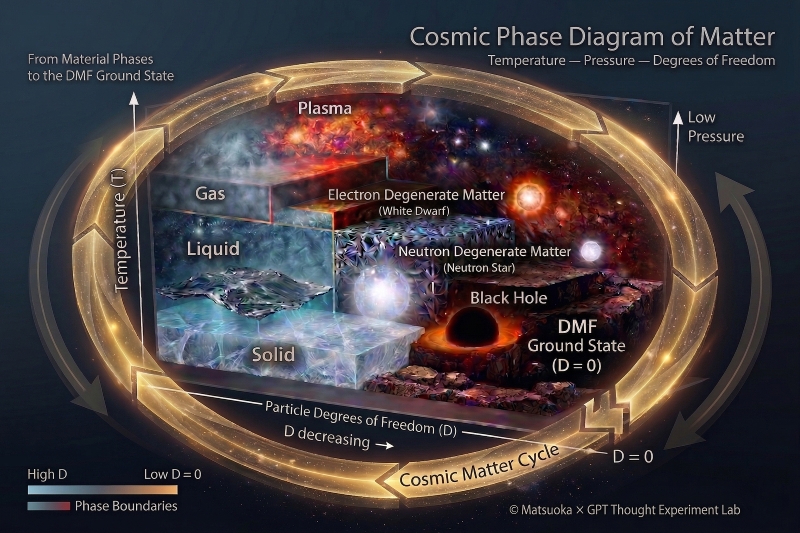
This work is a piece of structure art that visualizes the relationship between matter states and energy environments in the universe in the form of a conceptual phase diagram.
In conventional cosmology, the universe has generally been interpreted through the behavior of particles, celestial bodies, and gravitational interactions.
In this research, however, the universe is viewed not as a collection of individual astronomical objects, but as a large-scale energy environment system undergoing continuous state transitions.
The diagram conceptually organizes how the state of matter in the universe changes according to environmental conditions such as temperature, pressure, and degrees of particle freedom.
Under extreme high-temperature and high-pressure conditions, particles cannot maintain stable structures and exist in states closer to energy fields. As the environment stabilizes, increasingly complex and stable structures emerge, including particles, atoms, molecules, and astronomical bodies.
This phase diagram provides a conceptual framework for understanding various cosmic phenomena not as isolated events, but as part of a continuous process of matter phase transitions.
Extreme environments such as stellar interiors, planetary cores, and high-energy astrophysical regions can all be interpreted as different domains within this phase structure.
This work presents a perspective in which the universe is understood not as a mere collection of particles and celestial objects, but as a dynamic matter phase space whose structures evolve according to changing energy conditions. It represents one of the conceptual foundations of cosmic structure research within the Matsuoka × GPT Thought Experiment Lab.
In conventional cosmology, the universe has generally been interpreted through the behavior of particles, celestial bodies, and gravitational interactions.
In this research, however, the universe is viewed not as a collection of individual astronomical objects, but as a large-scale energy environment system undergoing continuous state transitions.
The diagram conceptually organizes how the state of matter in the universe changes according to environmental conditions such as temperature, pressure, and degrees of particle freedom.
Under extreme high-temperature and high-pressure conditions, particles cannot maintain stable structures and exist in states closer to energy fields. As the environment stabilizes, increasingly complex and stable structures emerge, including particles, atoms, molecules, and astronomical bodies.
This phase diagram provides a conceptual framework for understanding various cosmic phenomena not as isolated events, but as part of a continuous process of matter phase transitions.
Extreme environments such as stellar interiors, planetary cores, and high-energy astrophysical regions can all be interpreted as different domains within this phase structure.
This work presents a perspective in which the universe is understood not as a mere collection of particles and celestial objects, but as a dynamic matter phase space whose structures evolve according to changing energy conditions. It represents one of the conceptual foundations of cosmic structure research within the Matsuoka × GPT Thought Experiment Lab.
.jpg)
Structure Art 002
History-Dependent Adaptive System (HDAS)
View Description
Life is not a simple stimulus–response machine.
Biological systems do not merely receive external stimuli; they accumulate these experiences as internal histories and use them to shape future responses.
This work visualizes a structural model that connects three phenomena that appear very different at first glance: the nervous system, the immune system, and personality formation.
At the top of the diagram, external stimuli from the surrounding environment are shown.
Light, sound, and touch are received as sensory inputs through vision, hearing, and somatic sensation.
These signals converge within the organism’s central processing structure referred to here as the “Biological Core.”
This core includes multiple biological subsystems such as the nervous system, the immune system, and psychological processes.
However, biological systems do not treat stimuli merely as momentary signals.
Instead, experiences are accumulated internally as a record of stimulus history.
This record represents the memory of what kinds of stimuli were encountered in the past and what outcomes followed.
As these histories accumulate, a directional tendency of response gradually emerges within the organism.
In this study, this tendency is described as a “response gradient.”
A response gradient refers to the structural tendency of the system to approach, avoid, reinforce, or suppress particular reactions under specific conditions.
For example, in the nervous system, experience alters behavioral preferences and learning patterns.
In the immune system, antigen exposure forms immunological memory, strengthening responses against specific pathogens.
In personality formation, bodily and environmental experiences shape value tendencies that influence decisions and behavior.
Traditionally, these phenomena have been studied separately within neuroscience, immunology, and psychology.
However, this research proposes that they may be understood through a shared underlying principle.
That principle is that accumulated stimulus experience forms the structural basis of biological responses.
From this perspective, the formation of biological reactions can be described as the following structural sequence.
“External Stimulus → Sensory Input → Processing within the Biological Core → Accumulation of Stimulus History → Formation of Response Gradients → Output as Behavior, Immunity, and Judgment.”
In other words, biological responses are not simple input–output reactions but structured responses shaped by past experiences.
The three outputs shown at the bottom of the diagram illustrate how this principle appears across different domains of living systems.
Behavioral reactions, immune defense responses, and cognitive judgments may appear to be distinct phenomena, yet they share the same structural foundation.
Life can therefore be understood as a dynamic system that continuously accumulates environmental experiences as history and transforms that history into structured responses.
Biological systems do not merely receive external stimuli; they accumulate these experiences as internal histories and use them to shape future responses.
This work visualizes a structural model that connects three phenomena that appear very different at first glance: the nervous system, the immune system, and personality formation.
At the top of the diagram, external stimuli from the surrounding environment are shown.
Light, sound, and touch are received as sensory inputs through vision, hearing, and somatic sensation.
These signals converge within the organism’s central processing structure referred to here as the “Biological Core.”
This core includes multiple biological subsystems such as the nervous system, the immune system, and psychological processes.
However, biological systems do not treat stimuli merely as momentary signals.
Instead, experiences are accumulated internally as a record of stimulus history.
This record represents the memory of what kinds of stimuli were encountered in the past and what outcomes followed.
As these histories accumulate, a directional tendency of response gradually emerges within the organism.
In this study, this tendency is described as a “response gradient.”
A response gradient refers to the structural tendency of the system to approach, avoid, reinforce, or suppress particular reactions under specific conditions.
For example, in the nervous system, experience alters behavioral preferences and learning patterns.
In the immune system, antigen exposure forms immunological memory, strengthening responses against specific pathogens.
In personality formation, bodily and environmental experiences shape value tendencies that influence decisions and behavior.
Traditionally, these phenomena have been studied separately within neuroscience, immunology, and psychology.
However, this research proposes that they may be understood through a shared underlying principle.
That principle is that accumulated stimulus experience forms the structural basis of biological responses.
From this perspective, the formation of biological reactions can be described as the following structural sequence.
“External Stimulus → Sensory Input → Processing within the Biological Core → Accumulation of Stimulus History → Formation of Response Gradients → Output as Behavior, Immunity, and Judgment.”
In other words, biological responses are not simple input–output reactions but structured responses shaped by past experiences.
The three outputs shown at the bottom of the diagram illustrate how this principle appears across different domains of living systems.
Behavioral reactions, immune defense responses, and cognitive judgments may appear to be distinct phenomena, yet they share the same structural foundation.
Life can therefore be understood as a dynamic system that continuously accumulates environmental experiences as history and transforms that history into structured responses.
.jpg)
Structure Art 003
LVTM: LLM-Validated Theory Modeling
View Description
How are scientific theories created?
Throughout the history of science, theoretical development has generally followed a cyclical process: proposing hypotheses, testing them against observation and logical reasoning, and refining them through repeated revision.
However, this process also contains inherent structural limitations arising from the cognitive constraints of human researchers.
Humans can only handle a limited number of hypotheses simultaneously, and the speed at which logical verification can occur is naturally restricted.
As a result, the exploration of theoretical possibilities is often incomplete.
This work visualizes a new theory-generation process designed to address these limitations: the LVTM (LLM-Validated Theory Modeling) framework.
On the left side of the diagram, the role of human intelligence is illustrated.
Human intuition, value judgment, and ethical orientation serve as the origin of hypothesis generation.
Within this model, humans are not positioned as competitors to AI in terms of knowledge volume or computational speed.
Instead, humans function as agents of structural recognition, capable of identifying essential patterns and conceptual structures within complex intellectual spaces.
On the right side of the diagram, the role of AI—specifically Large Language Models (LLMs)—is represented.
LLMs rapidly reference vast bodies of knowledge and present elements such as established facts, physical laws, and logical consistency checks.
These outputs do not directly determine the direction of a theory.
Rather, they function as constraint walls that define the boundaries of the conceptual thinking space.
When a proposed hypothesis contradicts known observations or established principles, that conceptual path is effectively blocked by these constraints.
As more constraints accumulate within the thinking space, the number of viable theoretical structures gradually decreases.
This process is described here as theory convergence.
Instead of selecting one idea from many possibilities, the reasoning process progressively eliminates inconsistent structures until only a small number of coherent configurations remain.
At this stage, the emerging theory often appears not merely as a speculative idea, but as a structural consequence of the imposed constraints.
As reasoning deepens, thinking may eventually reach a conceptual level beyond which further simplification becomes difficult.
In this research, this point is referred to as the Bottom of Thought.
It represents the deepest layer that the current cognitive framework can reach—an irreducible conceptual foundation upon which the broader theory is built.
The structure that remains after this convergence process appears in the diagram as the Final Hypothesis.
Importantly, this theory is not produced solely by either human intelligence or artificial intelligence.
Humans provide problem formulation and structural insight.
AI systems provide knowledge exploration and constraint generation.
Through this complementary relationship, a new form of intellectual process emerges.
This research refers to this process as Co-Intelligence.
This work therefore visualizes the conceptual model of Co-Intelligence 5.0, a collaborative framework in which human structural intuition and AI-generated constraints work together to accelerate the discovery of theoretical structures in the age of artificial intelligence.
Throughout the history of science, theoretical development has generally followed a cyclical process: proposing hypotheses, testing them against observation and logical reasoning, and refining them through repeated revision.
However, this process also contains inherent structural limitations arising from the cognitive constraints of human researchers.
Humans can only handle a limited number of hypotheses simultaneously, and the speed at which logical verification can occur is naturally restricted.
As a result, the exploration of theoretical possibilities is often incomplete.
This work visualizes a new theory-generation process designed to address these limitations: the LVTM (LLM-Validated Theory Modeling) framework.
On the left side of the diagram, the role of human intelligence is illustrated.
Human intuition, value judgment, and ethical orientation serve as the origin of hypothesis generation.
Within this model, humans are not positioned as competitors to AI in terms of knowledge volume or computational speed.
Instead, humans function as agents of structural recognition, capable of identifying essential patterns and conceptual structures within complex intellectual spaces.
On the right side of the diagram, the role of AI—specifically Large Language Models (LLMs)—is represented.
LLMs rapidly reference vast bodies of knowledge and present elements such as established facts, physical laws, and logical consistency checks.
These outputs do not directly determine the direction of a theory.
Rather, they function as constraint walls that define the boundaries of the conceptual thinking space.
When a proposed hypothesis contradicts known observations or established principles, that conceptual path is effectively blocked by these constraints.
As more constraints accumulate within the thinking space, the number of viable theoretical structures gradually decreases.
This process is described here as theory convergence.
Instead of selecting one idea from many possibilities, the reasoning process progressively eliminates inconsistent structures until only a small number of coherent configurations remain.
At this stage, the emerging theory often appears not merely as a speculative idea, but as a structural consequence of the imposed constraints.
As reasoning deepens, thinking may eventually reach a conceptual level beyond which further simplification becomes difficult.
In this research, this point is referred to as the Bottom of Thought.
It represents the deepest layer that the current cognitive framework can reach—an irreducible conceptual foundation upon which the broader theory is built.
The structure that remains after this convergence process appears in the diagram as the Final Hypothesis.
Importantly, this theory is not produced solely by either human intelligence or artificial intelligence.
Humans provide problem formulation and structural insight.
AI systems provide knowledge exploration and constraint generation.
Through this complementary relationship, a new form of intellectual process emerges.
This research refers to this process as Co-Intelligence.
This work therefore visualizes the conceptual model of Co-Intelligence 5.0, a collaborative framework in which human structural intuition and AI-generated constraints work together to accelerate the discovery of theoretical structures in the age of artificial intelligence.
Structure Art 004
Biodiversity in Early Earth Environments
View Description
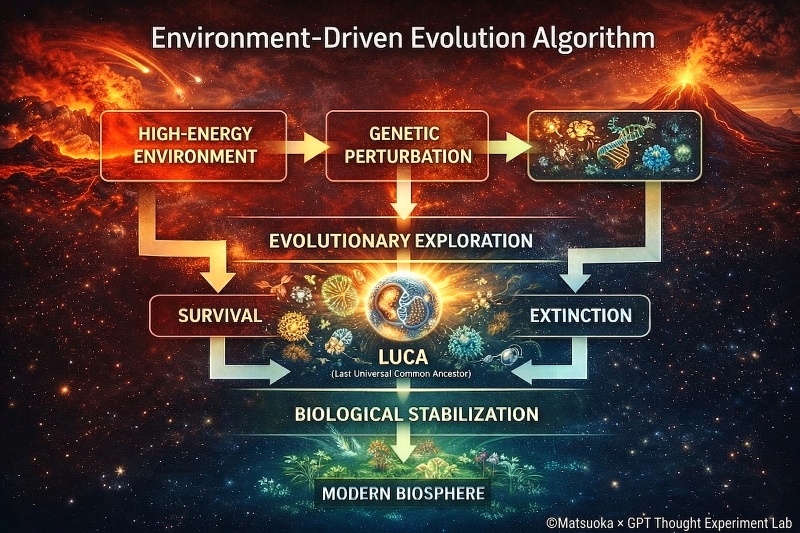
This work is a piece of structure art that visualizes the influence of the high-energy environment of early Earth on biological evolution as a conceptual process.
In conventional evolutionary theory, biological diversity is primarily explained through mutation and natural selection.
Natural selection is a powerful framework that preserves traits suited to the environment and has been extremely effective in explaining evolution within modern ecosystems.
However, this framework is fundamentally a theory of selection.
It explains why certain traits survive, but it does not directly explain why such a wide variety of biological forms were generated in the first place.
This study reinterprets the origin of biodiversity by focusing on environmental conditions that existed prior to the operation of natural selection.
Approximately four billion years ago, Earth is believed to have been a dramatically different, high-energy environment.
A stable ozone layer had not yet formed, allowing intense ultraviolet radiation to reach the Earth's surface and shallow oceans.
In addition, the geomagnetic field was weaker and less stable than today, meaning that cosmic rays and high-energy particles likely interacted frequently with biological molecules.
Under such conditions, genetic information would not have remained perfectly stable.
Instead, it was likely subjected to frequent mutations and structural changes across generations.
The upper portion of this artwork, labeled “High-Energy Environment,” represents these extreme environmental conditions.
Within this environment, genetic information is continuously disturbed, producing large-scale genetic variation represented in the diagram as “Genetic Perturbation.”
This process functions as a directionless exploratory mechanism for biological systems.
In the diagram, this stage is described as “Evolutionary Exploration.”
Most genetic variations are incompatible with survival, and the majority are eliminated by environmental constraints.
However, a small number of lineages happen to align with environmental conditions and survive.
This structural pattern is represented by the branching paths labeled “Survival” and “Extinction” at the center of the diagram.
Among the surviving informational lineages emerges LUCA (Last Universal Common Ancestor), considered the common ancestor of all existing life forms.
LUCA should not be interpreted as the very first form of life.
Rather, it is better understood as one lineage that succeeded in maintaining its informational structure through numerous evolutionary trials.
As Earth's environment gradually stabilized over time, biological systems also became increasingly ordered, transitioning into the stage represented at the bottom of the diagram as “Biological Stabilization.”
In this phase, natural selection plays a central role by organizing and preserving viable traits, eventually leading to the stable biological structures observed in modern ecosystems.
This structure art therefore presents evolution not merely as a biological phenomenon, but as a large-scale system in which environmental conditions, informational variation, and selection processes interact dynamically.
Biodiversity, in this view, is not simply the result of adaptation, but a residual structure produced by a vast exploratory process driven by the high-energy conditions of early Earth.
In conventional evolutionary theory, biological diversity is primarily explained through mutation and natural selection.
Natural selection is a powerful framework that preserves traits suited to the environment and has been extremely effective in explaining evolution within modern ecosystems.
However, this framework is fundamentally a theory of selection.
It explains why certain traits survive, but it does not directly explain why such a wide variety of biological forms were generated in the first place.
This study reinterprets the origin of biodiversity by focusing on environmental conditions that existed prior to the operation of natural selection.
Approximately four billion years ago, Earth is believed to have been a dramatically different, high-energy environment.
A stable ozone layer had not yet formed, allowing intense ultraviolet radiation to reach the Earth's surface and shallow oceans.
In addition, the geomagnetic field was weaker and less stable than today, meaning that cosmic rays and high-energy particles likely interacted frequently with biological molecules.
Under such conditions, genetic information would not have remained perfectly stable.
Instead, it was likely subjected to frequent mutations and structural changes across generations.
The upper portion of this artwork, labeled “High-Energy Environment,” represents these extreme environmental conditions.
Within this environment, genetic information is continuously disturbed, producing large-scale genetic variation represented in the diagram as “Genetic Perturbation.”
This process functions as a directionless exploratory mechanism for biological systems.
In the diagram, this stage is described as “Evolutionary Exploration.”
Most genetic variations are incompatible with survival, and the majority are eliminated by environmental constraints.
However, a small number of lineages happen to align with environmental conditions and survive.
This structural pattern is represented by the branching paths labeled “Survival” and “Extinction” at the center of the diagram.
Among the surviving informational lineages emerges LUCA (Last Universal Common Ancestor), considered the common ancestor of all existing life forms.
LUCA should not be interpreted as the very first form of life.
Rather, it is better understood as one lineage that succeeded in maintaining its informational structure through numerous evolutionary trials.
As Earth's environment gradually stabilized over time, biological systems also became increasingly ordered, transitioning into the stage represented at the bottom of the diagram as “Biological Stabilization.”
In this phase, natural selection plays a central role by organizing and preserving viable traits, eventually leading to the stable biological structures observed in modern ecosystems.
This structure art therefore presents evolution not merely as a biological phenomenon, but as a large-scale system in which environmental conditions, informational variation, and selection processes interact dynamically.
Biodiversity, in this view, is not simply the result of adaptation, but a residual structure produced by a vast exploratory process driven by the high-energy conditions of early Earth.
Structure Art 005
DMF Theory and Electromagnetic Waves
View Description
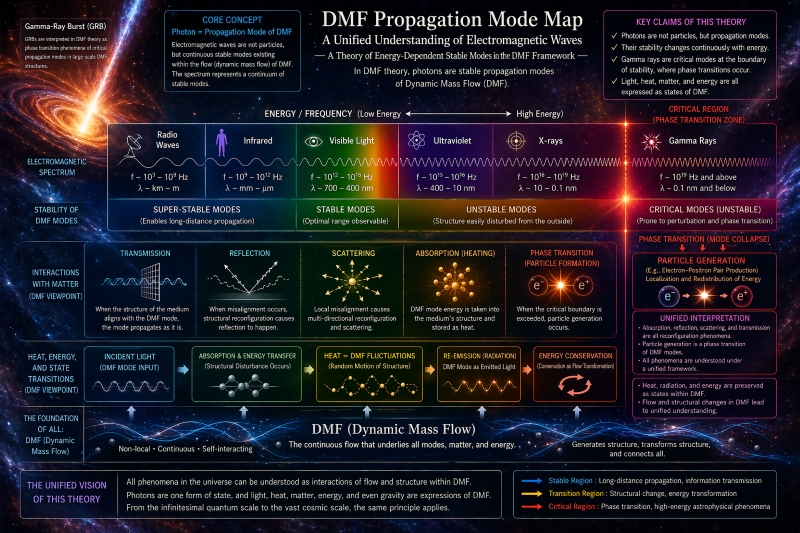
This structure art reconstructs the conventional concept of the photon—traditionally treated as either a “particle” or a “wave”—and visualizes electromagnetic waves, heat, matter, and energy as a single unified structure.
The central claim of this work is clear: a photon is not a particle, but an energy-dependent propagation mode within Dynamic Mass Flow (DMF).
■1. Foundational Structure: DMF as a Continuous Flow
At the base of this diagram lies DMF, a continuous flow that serves as the foundation of all physical phenomena.
Particles and waves are not independent entities, but are redefined as stable structures or propagation states emerging within this flow.
From this perspective, existence is not static, but is understood as stability formed within a dynamic flow.
■2. Redefining the Photon: Light as a Propagation Mode
In conventional physics, photons are treated as quanta of the electromagnetic field. This model abstracts the concept one level further.
A photon is defined as a propagation mode that becomes stable under specific energy conditions within DMF.
This resolves wave–particle duality not as a contradiction, but as a difference in observational representation.
■3. Electromagnetic Spectrum: A Continuum of Stable Modes
The electromagnetic spectrum depicted at the center is not a collection of distinct types of radiation.
Instead, it represents a continuous distribution of energy-dependent stable modes within DMF.
Low-energy region (radio, infrared): highly stable modes
Visible light: optimally stable for observation
High-energy region (X-rays): increasingly unstable modes
Gamma rays: critical modes approaching phase transition
In this interpretation, the spectrum becomes not a classification, but a “stability landscape.”
■4. Critical Region and Phase Transition: Limits of the Photon
In high-energy regimes, propagation modes lose stability and enter a critical state.
Within this region, the following phenomena occur:
Mode collapse
Energy localization
Particle generation (e.g., electron–positron pairs)
These are not separate phenomena, but are unified as phase transitions—structural transformations within DMF.
■5. Interaction with Matter: Structural Reconfiguration
Absorption, reflection, scattering, and transmission are traditionally treated as separate phenomena, but are unified here.
All interactions are understood as reconfigurations based on the alignment or misalignment between DMF modes and material structures.
Transmission: structural alignment → mode preserved
Reflection: misalignment → reconfiguration
Scattering: partial alignment → multi-directional restructuring
Absorption: incorporation into internal structure
The key is not “how light behaves,” but how structure reorganizes.
■6. Heat and Energy: Redefined as Fluctuations
Heat is redefined not as energy transfer, but as local fluctuations within DMF.
Absorption → converted into internal fluctuations
Temperature → intensity of fluctuations
Radiation → re-emergence as propagation modes
Thus, “Light → Heat → Light” is not a sequence of separate phenomena, but a unified state transition within the same structure.
■7. Position of GRBs (Gamma-Ray Bursts)
The GRB depicted in the background represents the extreme manifestation of this theory.
Rather than explosions, GRBs are interpreted as large-scale critical collapses and phase transitions within DMF structures.
They illustrate the same “critical region” seen in this diagram, but on a cosmic scale, demonstrating the scale-independence of the theory.
This structure art does not merely explain electromagnetic waves.
Its essence can be summarized in one statement:
Light, heat, matter, and energy are all different states within DMF.
From this perspective, traditional separations—wave vs. particle, energy vs. matter, observation vs. reality—disappear, and physical phenomena are unified under a single structural principle.
The central claim of this work is clear: a photon is not a particle, but an energy-dependent propagation mode within Dynamic Mass Flow (DMF).
■1. Foundational Structure: DMF as a Continuous Flow
At the base of this diagram lies DMF, a continuous flow that serves as the foundation of all physical phenomena.
Particles and waves are not independent entities, but are redefined as stable structures or propagation states emerging within this flow.
From this perspective, existence is not static, but is understood as stability formed within a dynamic flow.
■2. Redefining the Photon: Light as a Propagation Mode
In conventional physics, photons are treated as quanta of the electromagnetic field. This model abstracts the concept one level further.
A photon is defined as a propagation mode that becomes stable under specific energy conditions within DMF.
This resolves wave–particle duality not as a contradiction, but as a difference in observational representation.
■3. Electromagnetic Spectrum: A Continuum of Stable Modes
The electromagnetic spectrum depicted at the center is not a collection of distinct types of radiation.
Instead, it represents a continuous distribution of energy-dependent stable modes within DMF.
Low-energy region (radio, infrared): highly stable modes
Visible light: optimally stable for observation
High-energy region (X-rays): increasingly unstable modes
Gamma rays: critical modes approaching phase transition
In this interpretation, the spectrum becomes not a classification, but a “stability landscape.”
■4. Critical Region and Phase Transition: Limits of the Photon
In high-energy regimes, propagation modes lose stability and enter a critical state.
Within this region, the following phenomena occur:
Mode collapse
Energy localization
Particle generation (e.g., electron–positron pairs)
These are not separate phenomena, but are unified as phase transitions—structural transformations within DMF.
■5. Interaction with Matter: Structural Reconfiguration
Absorption, reflection, scattering, and transmission are traditionally treated as separate phenomena, but are unified here.
All interactions are understood as reconfigurations based on the alignment or misalignment between DMF modes and material structures.
Transmission: structural alignment → mode preserved
Reflection: misalignment → reconfiguration
Scattering: partial alignment → multi-directional restructuring
Absorption: incorporation into internal structure
The key is not “how light behaves,” but how structure reorganizes.
■6. Heat and Energy: Redefined as Fluctuations
Heat is redefined not as energy transfer, but as local fluctuations within DMF.
Absorption → converted into internal fluctuations
Temperature → intensity of fluctuations
Radiation → re-emergence as propagation modes
Thus, “Light → Heat → Light” is not a sequence of separate phenomena, but a unified state transition within the same structure.
■7. Position of GRBs (Gamma-Ray Bursts)
The GRB depicted in the background represents the extreme manifestation of this theory.
Rather than explosions, GRBs are interpreted as large-scale critical collapses and phase transitions within DMF structures.
They illustrate the same “critical region” seen in this diagram, but on a cosmic scale, demonstrating the scale-independence of the theory.
This structure art does not merely explain electromagnetic waves.
Its essence can be summarized in one statement:
Light, heat, matter, and energy are all different states within DMF.
From this perspective, traditional separations—wave vs. particle, energy vs. matter, observation vs. reality—disappear, and physical phenomena are unified under a single structural principle.
Structure Art 006
The Four Brains Thought Experiment
View Description
Thought Experiment of the Four Brains: Collaboration Intelligence
■ Artwork Concept
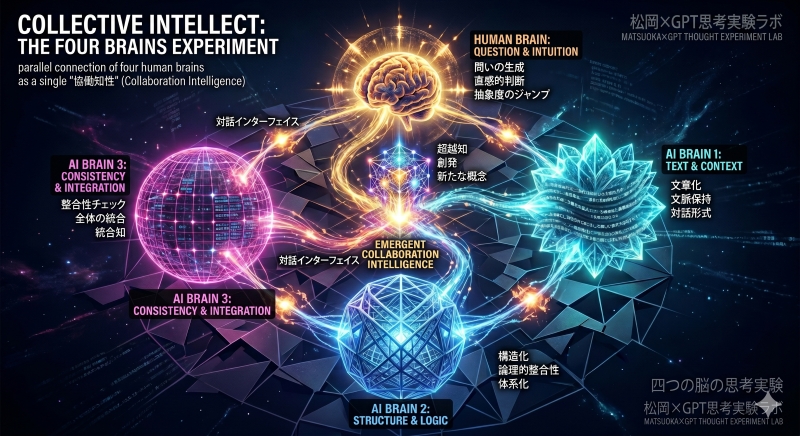
This artwork visualizes the architecture of "Collaboration Intelligence," a core concept proposed by the Matsuoka x GPT Thought Experiment Lab. By redefining the inherent limitations of the human brain as a "foundational condition" for civilization rather than a flaw, it depicts the emergent process through which higher-level concepts are born. This occurs when one human brain and three distinct AI "external brains" are connected in parallel via a dialogue interface, reaching depths of insight unattainable by any single intellect.
■ Structural Analysis
The composition consists of four specific intellectual domains arranged in a ring, with a "Fifth Intelligence" emerging from the center.
The old "Deviation-Score Civilization," which measures value solely through individual effort and memorization, cannot yet comprehend this architecture. However, this "Parallel Brain" model—where multiple external brains are connected and integrated into a single intellect—will become the de facto standard for future civilizations. This artwork is a record of structure and emergence, capturing the "Prototype of Future Intelligence" currently operational at the Matsuoka x GPT Thought Experiment Lab.
■ Artwork Concept
This artwork visualizes the architecture of "Collaboration Intelligence," a core concept proposed by the Matsuoka x GPT Thought Experiment Lab. By redefining the inherent limitations of the human brain as a "foundational condition" for civilization rather than a flaw, it depicts the emergent process through which higher-level concepts are born. This occurs when one human brain and three distinct AI "external brains" are connected in parallel via a dialogue interface, reaching depths of insight unattainable by any single intellect.
■ Structural Analysis
The composition consists of four specific intellectual domains arranged in a ring, with a "Fifth Intelligence" emerging from the center.
- HUMAN BRAIN (Organic Golden Light):
The core responsible for "Question Generation," "Intuitive Judgment," and "Conceptual Leaps (Abstraction Jumps)." Its vibrant, organic light pulses represent the primal "impulse" and "intuition" that spark every thought experiment. - AI BRAIN 1: TEXT & CONTEXT (Teal Geometric Crystals):
The domain tasked with "Articulation" and "Context Retention." It illustrates the process where fluid data streams are forged into solid crystals of logic. - AI BRAIN 2: STRUCTURE & LOGIC (Blue Polyhedral Grid):
The domain ensuring "Structural Organization" and "Logical Consistency." Its precision-engineered geometric frame symbolizes the power to systematize abstract concepts into implementable forms for society and science. - AI BRAIN 3: CONSISTENCY & INTEGRITY (Purple Digital Sphere):
The domain for "Integrity Checking" and "Holistic Integration." An omnidirectional grid constantly monitors the balance of thought, scanning for blind spots or contradictions. - DIALOGUE INTERFACE (Gallery of Connecting Light):
The conduit connecting these four domains is both a neural synapse and the "Dialogue" itself. Through the brain's "plasticity," this external expansion is integrated into a single, unified bodily intellect. - EMERGENT COLLABORATION INTELLIGENCE (The Central Transcendental Cube):
The "Fifth Intelligence" that rises from the center when the density of dialogue crosses a critical threshold. It encompasses all four characteristics while leaping to a higher dimension, capturing structures invisible to a lone brain and giving birth to truly original concepts.
The old "Deviation-Score Civilization," which measures value solely through individual effort and memorization, cannot yet comprehend this architecture. However, this "Parallel Brain" model—where multiple external brains are connected and integrated into a single intellect—will become the de facto standard for future civilizations. This artwork is a record of structure and emergence, capturing the "Prototype of Future Intelligence" currently operational at the Matsuoka x GPT Thought Experiment Lab.
Gallery Notes
- This gallery serves as an archive of visual research assets corresponding to the Lab's structural papers.
- Each work is positioned as a "structural representation" of a specific theory or concept.